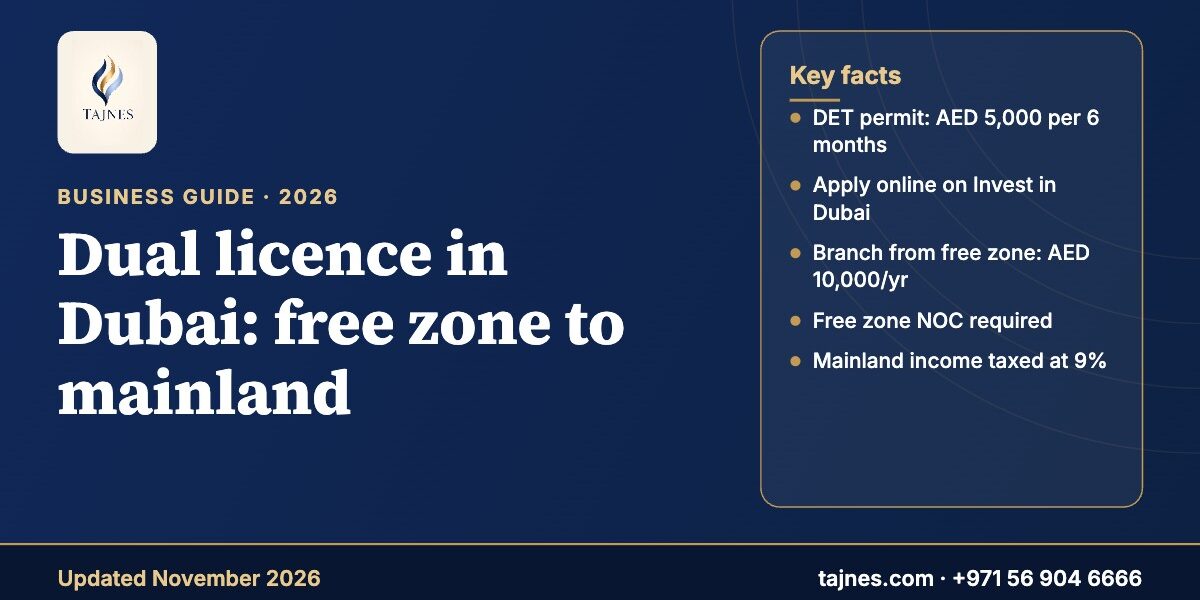
A dual licence in Dubai lets a free zone company work on the mainland without setting up a second company. Since Dubai Executive Council Resolution No. 11 of 2025, there are two official routes: the Free Zone Mainland Operating Permit from the Department of Economy and Tourism (DET), at AED 5,000 per six months, or a DET-licensed mainland branch of the free zone company. Both need your free zone’s approval and separate records for mainland revenue.
Key facts
- Legal basis: Executive Council Resolution No. 11 of 2025 on free zone establishments’ activities outside the free zone, issued on 3 March 2025.
- Six-month permit: launched on 8 October 2025, applied for online on Invest in Dubai, AED 5,000 per six months, renewable; you need a Dubai Unified Licence (DUL).
- First-phase activities: non-regulated activities such as technology, consultancy, design, professional services and trading. Regulated sectors are planned for later phases.
- Branch route: a DET branch licence valid for one year and renewable; the resolution sets AED 10,000 a year for a branch operating from the free zone.
- Approvals: your free zone authority must approve, plus the sector regulator where the activity needs one.
- Excluded: financial firms licensed in the DIFC.
What “dual licence” means in Dubai today
For years, a dual licence was a deal between one free zone and the former Dubai Economy: DAFZ has offered one since 2017 and DMCC since December 2022. The 2025 resolution created one framework for all of Dubai. A free zone company can now choose how to reach mainland customers:
- Free Zone Mainland Operating Permit: the light option for testing the mainland market or for project work, six months at a time.
- Branch operating from the free zone: a DET branch licence that lets you serve mainland clients from your free zone office (one year, AED 10,000 a year under the resolution).
- Branch located on the mainland: a DET branch with its own mainland address, for companies that need a local presence; fees follow the usual DET schedule.
- A separate mainland company: still the simplest choice when most of your customers are onshore or your activity is regulated.
How to get the mainland permit, step by step
- Check that your activity is on DET’s list of activities permitted for free zone companies (the first phase covers non-regulated activities).
- Make sure your free zone licence is valid and ask your free zone authority for a no-objection certificate (NOC).
- Get your Dubai Unified Licence (DUL) number if you do not have one yet.
- Apply online on Invest in Dubai, choose the permit or the branch route and upload your free zone licence, the NOC and your company documents.
- Pay the DET fee (AED 5,000 per six months for the permit) and any free zone NOC fee.
- Keep separate accounts for mainland revenue and renew before expiry.
Free zone rules: the DMCC example
Each free zone adds its own conditions and fees. DMCC lists AED 265 for its NOC to open a branch and offers a Dual Licence Office Permit (AED 5,000 a year) that lets your DET-licensed branch work from your JLT office. DMCC’s guideline asks for an Ejari covering the whole unit, an office unit with at least 300 sq ft of dedicated workspace, a landlord NOC, and it excludes business centres, co-working spaces, retail and industrial activities. Other free zones, such as Meydan Free Zone, publish their own packages, so always check your zone’s latest fee schedule.
Corporate tax: mainland income is taxed at 9%
DET says revenue earned on the mainland under the permit is subject to 9% corporate tax and must be recorded separately. For a Qualifying Free Zone Person, income from mainland customers is generally non-qualifying unless it comes from qualifying activities, and non-qualifying revenue must stay within the de minimis limit: the lower of 5% of total revenue or AED 5 million (Ministerial Decision No. 229 of 2025, which replaced Decision No. 265 of 2023). Income of a mainland branch is treated separately and taxed at the standard rates. Speak to a tax adviser before you invoice mainland clients, because breaking the de minimis rule can cost you qualifying status. See our UAE corporate tax guide.
Which route should you choose?
- A few mainland projects: the six-month permit.
- Regular mainland clients, but you want to keep your free zone office: a branch operating from the free zone.
- A shop, a regulated activity or mostly mainland customers: a mainland branch or a separate mainland company. Compare the options in mainland vs free zone in the UAE.
Not sure your activity qualifies? Read how to choose business activities for a UAE licence or book a consultation. Estimate your full budget with our cost calculator and see all our company setup services.
Frequently asked questions
Can a free zone company work on the Dubai mainland?
Yes, with DET authorisation. Under Resolution No. 11 of 2025, a free zone company can get the six-month Free Zone Mainland Operating Permit or a DET branch licence, with its free zone’s approval. Without one of them, it should not trade directly with mainland customers.
How much does a dual licence cost in Dubai?
The DET permit costs AED 5,000 per six months, and the resolution sets AED 10,000 a year for a branch operating from the free zone. Your free zone adds its own NOC or permit fees (DMCC, for example, lists AED 265 for a branch NOC). Our calculator itemises the rest.
Do I need a mainland office for the permit?
The DET announcement does not mention a mainland office for the six-month permit, and a branch operating from the free zone uses your free zone premises. A branch located on the mainland needs its own address with a lease registered in Ejari; see Ejari and office requirements. Some free zones set office conditions of their own.
Can my free zone staff do the mainland work?
Yes. The resolution allows a free zone company to use its existing staff for the authorised mainland activity.
Related guide: expanding a company from abroad instead? See how to set up a branch of a foreign company in Dubai.
Related guide: need to add an activity, a partner or a new address later? Read how to amend a trade licence in Dubai.
Related guide: every free zone company must register for corporate tax, even before trading on the mainland. See the UAE corporate tax registration deadline.
New guide: the mainland permit needs a Dubai Unified Licence. See what the DUL is and how to get it.
New guide: expanding a foreign company to the capital? See how to register a branch of a foreign company in Abu Dhabi: MoET steps, ADDED licence, free zones and fees.
General information, updated November 2026, based on Dubai Executive Council Resolution No. 11 of 2025 (Dubai Legislation Portal), the Dubai Media Office (Free Zone Mainland Operating Permit, October 2025), DMCC’s schedule of charges and Dual Licence Office Permit guideline, DAFZ, Cabinet Decision No. 100 of 2023 and Ministerial Decision No. 229 of 2025. Not legal or tax advice. Fees and rules are set by the authorities and can change.