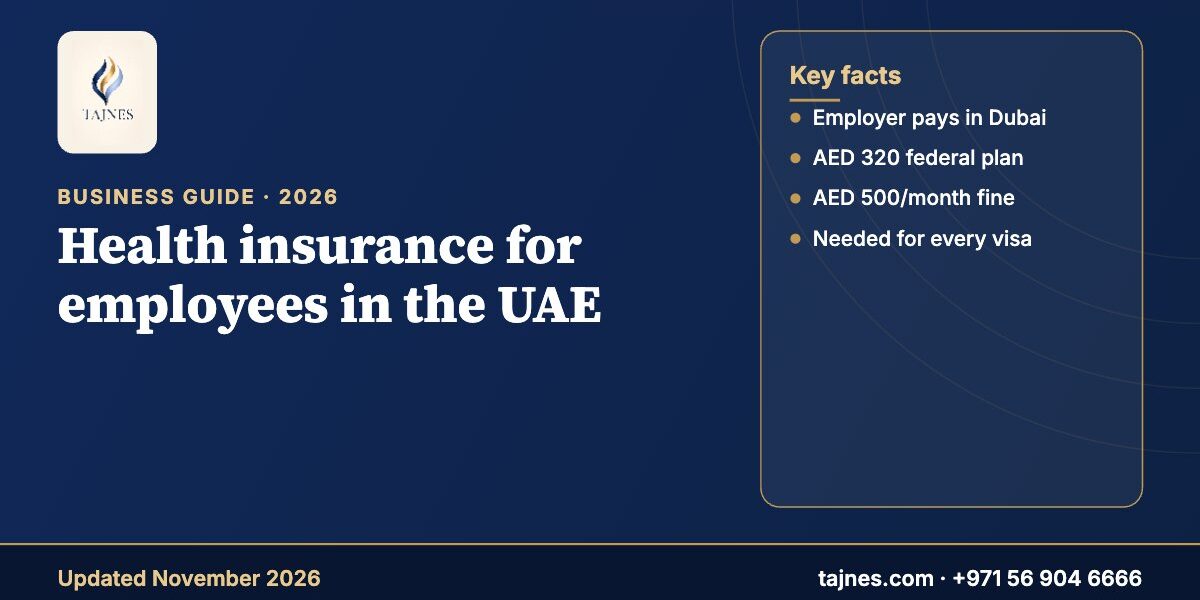
Health insurance for employees is mandatory in every emirate of the UAE. In Dubai (Law No. 11 of 2013) and Abu Dhabi (Law No. 23 of 2005) the employer must insure its staff, and since 1 January 2025 a federal scheme requires private-sector employers in Sharjah, Ajman, Umm Al Quwain, Ras Al Khaimah and Fujairah to insure employees, with a basic plan from AED 320 a year.
Key facts
- Dubai: the employer pays the full premium and may not deduct it from salaries (Dubai Health Insurance Law No. 11 of 2013, ISAHD).
- Dubai fines: AED 500 per month of delay for each uninsured person, and AED 10,000 per employee charged for the cover (Executive Council Resolution No. 7 of 2016).
- Federal basic plan (northern emirates): AED 320 a year, 2-year policy, ages 1–64, pre-existing conditions covered with no waiting period (u.ae, MOHRE).
- Residence visas: valid health insurance is required to issue or renew a residence permit (ICP).
- Dubai minimum plan: the Essential Benefits Plan for salaries of AED 4,000 a month or less, with an AED 150,000 annual limit (DHA).
- Unemployment insurance (ILOE) is a separate scheme paid by the worker: AED 5 or AED 10 a month (u.ae).
Is health insurance mandatory for employees in the UAE?
Yes. Each emirate has its own law, and the federal scheme fills the gap in the northern emirates:
| Emirate | Legal basis | Who insures the employee | Spouse and children |
|---|---|---|---|
| Dubai | Law No. 11 of 2013 (Dubai Health, ISAHD) | Employer, full premium | The sponsor (usually the employee) must insure them |
| Abu Dhabi | Law No. 23 of 2005 (Department of Health) | Employer or sponsor | Employer or sponsor: one spouse and three children under 18 |
| Sharjah, Ajman, Umm Al Quwain, Ras Al Khaimah, Fujairah | Federal scheme from 1 January 2025 (Cabinet decision, MOHRE) | Employer, before the residence is issued or renewed | Can join the basic plan at the same price |
Sources: ISAHD FAQ (Dubai), u.ae health insurance and the MOHRE health insurance scheme.
Who pays for health insurance: the employer or the employee?
For the employee, the employer pays. Dubai’s rules state that the premium must not be deducted from salaries under any circumstances, and the federal scheme requires the employer to buy the policy before the residence permit is issued or renewed. In Dubai the employer does not have to insure the employee’s family; whoever sponsors the spouse, children or a domestic worker must arrange and pay for their cover.
What does the AED 320 basic plan cover?
- Inpatient care: 20% co-payment, capped at AED 500 per visit and AED 1,000 a year.
- Outpatient care: 25% co-payment, capped at AED 100 per visit; no co-payment for a follow-up within 7 days.
- Medicines: 30% co-payment, up to AED 1,500 a year.
- Chronic and pre-existing conditions are covered from day one; pregnancy, childbirth and dental care are not.
- The policy runs for 2 years, and the second-year premium is refunded if the visa is cancelled.
What is the minimum plan in Dubai and Abu Dhabi?
In Dubai, employees earning AED 4,000 a month or less can be covered by the Essential Benefits Plan (EBP): AED 150,000 annual limit, a 20% hospital co-payment (capped at AED 500 per visit and AED 1,000 a year) and 30% on prescriptions. Better-paid staff need an enhanced plan from a licensed insurer. In Abu Dhabi, the Basic Plan covers workers earning AED 5,000 or less (AED 4,000 or less if housing is provided); UAE nationals are covered by Thiqa. Premiums are set by the insurers, so get quotes before you budget.
What are the fines for not having health insurance in Dubai?
| Violation | Fine |
|---|---|
| Not enrolling an employee or sponsored person | AED 500 per month of delay, per person |
| Charging the employee all or part of the premium | AED 10,000 per beneficiary, plus a refund |
| Not giving the insurance card to the beneficiary | AED 1,000 |
| No policy when the residence is issued or renewed | AED 1,000 |
Repeat violations within a year are doubled, up to AED 500,000 (Executive Council Resolution No. 7 of 2016).
How does health insurance affect visas?
ICP lists valid health insurance as a required document for residence renewals, including employees of private and free zone companies. In Dubai the law covers the whole emirate, free zones included. Golden Visa investors, entrepreneurs and specialists must hold comprehensive insurance for themselves and their family. Our guides to the medical test and Emirates ID and the residence visa through your company explain the other steps.
Is unemployment insurance the same thing?
No. The Involuntary Loss of Employment (ILOE) scheme under Federal Decree-Law No. 13 of 2022 is paid by the worker: up to AED 5 a month for a basic salary of AED 16,000 or less, and AED 10 above that. It pays 60% of salary for up to three months after a job loss. Not subscribing, or not paying, costs AED 400 (u.ae).
Employer checklist
- Buy a compliant policy for every employee before the residence is issued or renewed.
- Pay the full premium for employees; never deduct it from wages.
- Give each employee the insurance card and keep the policy on file.
- Renew on time with the visa, and cancel together with it.
- Tell staff to subscribe to ILOE and to insure the family members they sponsor.
Setting up your team? Read how to hire your first employee in Dubai, book a free consultation or build an estimate with the cost calculator.
Frequently asked questions
Is health insurance mandatory for employees in Sharjah and the northern emirates?
Yes. Since 1 January 2025, private-sector employers in Sharjah, Ajman, Umm Al Quwain, Ras Al Khaimah and Fujairah must insure employees and domestic workers before their residence is issued or renewed. The basic plan costs AED 320 a year.
Can my employer deduct health insurance from my salary in Dubai?
No. In Dubai the employer must pay the full premium for employees and cannot deduct it from salaries. Charging the employee can cost the employer AED 10,000 per beneficiary.
Does my employer have to insure my spouse and children?
Not in Dubai: the sponsor of the family, usually the employee, must insure them. In Abu Dhabi the employer or sponsor must cover one spouse and three children under 18.
What is the fine for not having health insurance in Dubai?
AED 500 for each month of delay for each uninsured employee or sponsored person, doubled for repeat violations within a year.
What does the AED 320 basic health insurance plan cover?
Inpatient, outpatient and medicine cover with co-payments (20%, 25% and 30%), including chronic and pre-existing conditions from day one. Pregnancy, childbirth and dental care are excluded.
Is unemployment insurance the same as health insurance?
No. ILOE unemployment insurance is a separate federal scheme paid by the worker (AED 5 or 10 a month); health insurance is paid by the employer.
About Tajnes: Tajnes Business Management Est. is a Dubai company setup consultancy (DET licence no. 1219274) at Al Saqr Business Tower, Sheikh Zayed Road, Dubai. We handle licences, visas, renewals and bank account applications with open-book pricing. Call +971 56 904 6666 or book a free consultation.
New guide: changing jobs in the UAE – how to transfer your visa and work permit to a new employer.
General information, updated November 2026, based on Dubai Law No. 11 of 2013, Executive Council Resolution No. 7 of 2016, Abu Dhabi Law No. 23 of 2005, MOHRE, ICP and u.ae. Rules, plans and premiums can change; confirm with the authority or a licensed insurer. Not legal or insurance advice.