
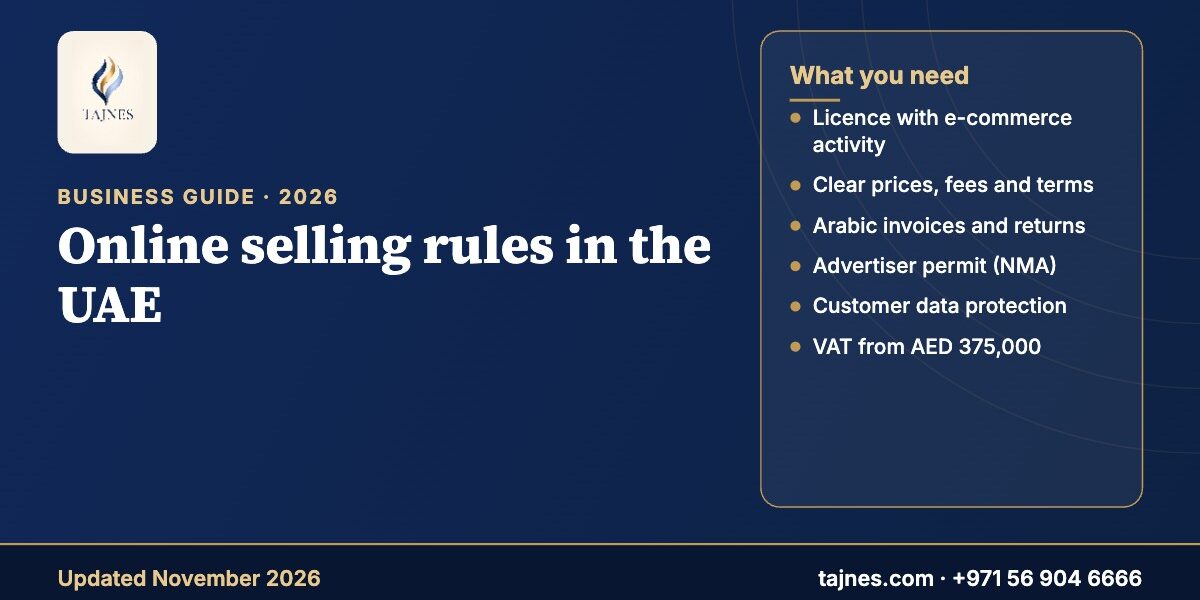
The online trading rules in the UAE start with a licence: anyone selling through a website, an app, Instagram, TikTok or WhatsApp needs a trade licence that covers e-commerce, under Federal Decree-Law No. 14 of 2023 on trading by modern technological means. You must also follow the consumer protection rules (clear prices, Arabic invoices, returns), protect customer data and, if you publish promotional content on social media, hold an advertiser permit from the National Media Authority. Below are the main laws, what they ask from online sellers and the steps to sell online legally.
Key facts
- E-commerce law: Federal Decree-Law No. 14 of 2023, in force since 16 September 2023. It covers websites, apps, social media platforms and digital marketplaces, for physical and digital goods.
- Licence: a mainland licence with an e-commerce activity (for example Dubai e-Trader or Tajer Abu Dhabi) or a free zone licence. According to u.ae, e-commerce licences also need TDRA approval.
- Consumer law: Federal Law No. 15 of 2020 and its executive regulation, Cabinet Resolution No. 66 of 2023 (in force 14 October 2023): Arabic invoices, clear prices, return and exchange terms.
- Advertiser permit: issued by the National Media Authority; free for the first three years, then AED 1,000, and processed in about three working days.
- Customer data: Federal Decree-Law No. 45 of 2021 on personal data protection.
- VAT: registration is mandatory above AED 375,000 of taxable supplies in 12 months and voluntary from AED 187,500.
Which law applies to online selling in the UAE?
The main law is Federal Decree-Law No. 14 of 2023 on trading by modern technological means. It applies to anyone who trades online in the UAE, including the logistics and digital payment services linked to that trade, and to free zones in specified cases. The government portal u.ae explains that it covers websites, apps, social media platforms and digital marketplaces, whether you sell physical products or digital ones. The decree-law leaves the fine amounts to a Cabinet resolution, so check the latest penalties with the Ministry of Economy and Tourism.
What the e-commerce law asks from sellers
- Get the approvals, permits and licences required before you start, and sell restricted goods only after the competent authority approves them.
- Publish your prices, delivery fees and payment fees, and make your terms or digital contract available before the customer buys.
- Do not mislead customers or publish incorrect product information.
- Issue a detailed electronic (non-paper) invoice.
- Keep your store technically safe, in line with cybersecurity standards, and have a business continuity plan.
- Show your digital trader licence, address, phone numbers and website publicly on your store or page.
What your customers can expect
- Return or replacement for goods that are defective, not as described or delivered late, with exceptions such as used or perishable items.
- No trading or disclosure of their data without consent.
- No extra delivery or payment fees beyond those announced.
- No arbitration clause in a digital contract worth less than AED 50,000.
Selling on Instagram, TikTok or WhatsApp: do you need a licence?
Yes. The e-commerce law requires the licences and approvals for your activity, and asks you to display your licence. A social media shop is treated like any other online store. The usual routes are:
- Dubai e-Trader: a home-based sole proprietorship that dubai.ae describes as made for individuals selling products or services through social media and online platforms. Eligibility depends on nationality and residence, so check it on Invest in Dubai.
- Tajer Abu Dhabi: open to UAE citizens and residents, with more than 1,200 activities and no physical office needed in its first years, according to ADDED.
- A mainland company with an e-commerce activity: suits larger shops, stock, staff and visas.
- A free zone licence: many free zones offer e-commerce activities; check how you can deliver to customers on the mainland.
Our e-commerce licence guide compares these routes and what they cost.
Consumer protection rules for online shops
Federal Law No. 15 of 2020 on consumer protection (amended in 2023) covers goods sold through e-commerce platforms registered in the UAE. Its executive regulation, Cabinet Resolution No. 66 of 2023, came into force on 14 October 2023. For online sellers, the main points are:
- Give your licensing details, and show product, contract, payment and warranty information in Arabic (other languages can be added).
- Issue a dated invoice in Arabic.
- List the producer or importer, trademark, origin, dates, warnings and your return and exchange terms for each product.
- Do not use “no return, no exchange” notices, except in the cases the regulation allows.
- Refund the customer if a defect appears within 30 days.
- Show clear prices and do not add a surcharge for card payments.
- Get a prior permit before you run discounts or promotions.
The penalties are serious. The regulation’s schedule lists fines of AED 100,000 for an invoice that is not in Arabic and for missing e-commerce product information, and u.ae notes that the law allows fines of up to AED 2 million and up to two years in prison for serious breaches such as misleading prices or false data.
Advertiser permit for social media content
The media law, Federal Decree-Law No. 55 of 2023, has been in force since 1 December 2023. Permits are now issued by the National Media Authority, which replaced the UAE Media Council. According to its service page, individuals who publish advertising or media content on social media, websites or other digital platforms, paid or free, need a permit:
- Fee: free for the first three years, then AED 1,000.
- Documents: Emirates ID, passport, a photo and a commercial licence.
- Conditions: good conduct, a training programme and no previously cancelled permit.
- Time: about three working days. Visitors on a visit visa apply for a separate permit.
Media violations and their penalties are set out in Cabinet Resolution No. 42 of 2025, in force since 29 May 2025. If you, your staff or influencers you hire promote your products on personal accounts, check with the National Media Authority whether a permit is needed.
Customer data and payments
Federal Decree-Law No. 45 of 2021 on personal data protection, in force since 2 January 2022, applies to online shops that collect customer data. Ask for clear consent unless an exception applies (such as processing needed to deliver an order), let customers access, correct or delete their data and refuse direct marketing, keep the data secure and report any breach. DIFC and ADGM have their own data protection laws. Use a licensed payment provider, announce any payment fees in advance, and open a business bank account in the company name: see our guide to bank account documents.
Tax for online sellers
VAT registration is mandatory once your taxable supplies pass AED 375,000 in 12 months, and voluntary from AED 187,500 (see our VAT registration guide). Companies pay corporate tax at 9% on taxable income above AED 375,000, and an individual trading in their own name registers for corporate tax only when turnover passes AED 1 million in a year. Our corporate tax guide explains the reliefs.
Steps to sell online legally in the UAE
- Choose your route: e-Trader, Tajer Abu Dhabi, a mainland company or a free zone.
- Pick the e-commerce activity and check whether your products need another authority’s approval.
- Get the licence, plus TDRA approval where required.
- Set up your store or page with your licence details, address, contact numbers, prices, delivery fees and return policy, in Arabic and English.
- Issue Arabic invoices, connect a licensed payment provider and open a business bank account.
- Apply for an advertiser permit if you publish promotional content on social media.
- Register for VAT when you reach the threshold and keep your records.
Frequently asked questions
What are the online trading rules in the UAE?
You need a licence that covers e-commerce, you must publish clear prices, fees and terms, issue Arabic invoices, accept returns for defective or misdescribed goods, protect customer data, and hold an advertiser permit if you publish promotional content on social media.
Can I sell on Instagram without a trade licence in the UAE?
No. Selling through social media counts as online trading under Federal Decree-Law No. 14 of 2023, which requires the licences for your activity. Dubai e-Trader, Tajer Abu Dhabi, a mainland company or a free zone licence are the usual options.
Do I need an advertiser permit to promote my own products?
The National Media Authority’s permit covers individuals who publish advertising or media content on digital platforms, paid or free. If you or your staff promote products on personal accounts, check with the Authority before you post.
Do I have to accept returns for online orders?
Yes for goods that are defective, not as described or delivered late, with exceptions such as used or perishable items. Under the consumer protection regulation, a customer is entitled to a refund if a defect appears within 30 days.
Tajnes can help you choose the right licence for selling online, apply for it and keep your shop compliant. Book a free consultation, check the government fees with our cost calculator or see all our services.
General information, updated November 2026, based on uaelegislation.gov.ae (Federal Decree-Laws No. 14 of 2023, 55 of 2023 and 45 of 2021, Federal Law No. 15 of 2020, Cabinet Resolution No. 66 of 2023), u.ae, the National Media Authority, dubai.ae, ADDED and the Federal Tax Authority. Rules and fees can change; check with the relevant authority before you act. Not legal advice.