
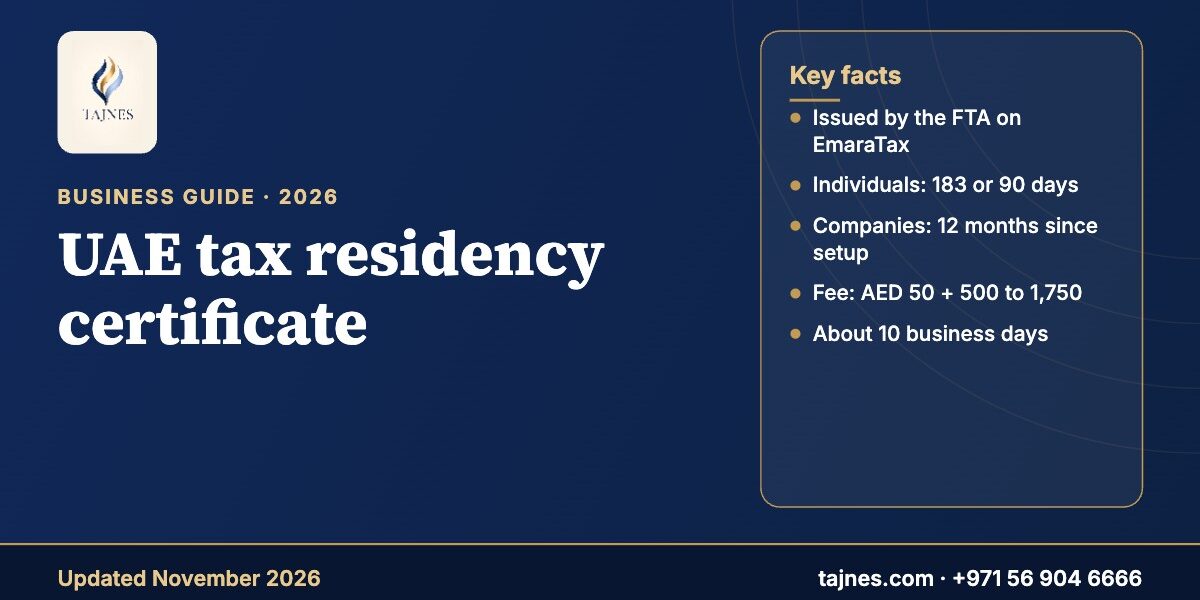
A UAE tax residency certificate (TRC) is an official document from the Federal Tax Authority (FTA) confirming that a person or company is a UAE tax resident for a chosen 12-month period. You apply online on EmaraTax: individuals qualify mainly through 183 days in the UAE (or 90 days with a residence permit and a home or job here), and UAE companies once they have existed for at least 12 months. The FTA lists a AED 50 submission fee plus a certificate fee of AED 500 to AED 1,750, and about 10 business days to issue. The certificate is mostly used to claim the benefits of a double tax treaty abroad.
Key facts
- Issued by: the Federal Tax Authority, through EmaraTax (Other Services → Tax Residency Certificate).
- Two types: a certificate for a specific double tax agreement (DTA) country, or one for “other purposes”.
- Period covered: one tax period or another 12-month period you choose; the current or a past period, not a future one.
- Fees (FTA, October 2026): AED 50 submission + AED 500 if you have a Corporate Tax TRN, otherwise AED 1,000 for individuals or AED 1,750 for companies; AED 250 per printed copy.
- Time: about 10 business days for the electronic certificate.
- Not eligible: branches of foreign companies, because they are not established under UAE law.
Who is a UAE tax resident?
The rules come from Cabinet Decision No. 85 of 2022, in force since 1 March 2023, with Ministerial Decision No. 27 of 2023 for individuals.
Individuals
You are a UAE tax resident if you meet any one of these tests:
- your usual or main place of residence and your centre of financial and personal interests are in the UAE;
- you were physically in the UAE for 183 days or more in a 12-month period; or
- you were in the UAE for 90 days or more in that period, you are a UAE or GCC national or hold a valid UAE residence permit, and you have a permanent home in the UAE or work or run a business here.
Companies
A company is a UAE tax resident if it is incorporated or otherwise established or recognised under UAE law, which includes mainland and free zone companies, or if it is treated as resident under UAE tax law (for example through effective management and control in the UAE). For a TRC, the FTA also requires the company to have existed for at least 12 months. Members of a Corporate Tax Group apply one by one.
Documents the FTA asks for
Individuals: Emirates ID and passport, and an official entry and exit report from ICP or the local immigration authority. For the 90-day test, add proof of UAE employment or business, or of a permanent home; for the centre-of-interests test, add proof of your financial and personal ties and main residence. For a treaty certificate, add proof of UAE income where relevant.
Companies: valid trade licence and lease agreement, certificate of incorporation, memorandum of association (certified for a treaty certificate), Corporate Tax TRN if you have one, Emirates ID and passport of the authorised signatory with proof of authority, and proof of effective management and control where it applies. The other country’s tax authority may ask for more, such as accounts or bank statements.
How to apply on EmaraTax: 6 steps
- Log in to EmaraTax (or create an account; an account from the old TRC portal can be linked).
- Open Other Services, then Tax Residency Certificate.
- Select your Corporate Tax TRN, or “No Tax Registration Number”.
- Choose a treaty country, or “other purposes”.
- Fill in the form, upload the documents and add printed copies or the stamping of a foreign country’s form if you need it.
- Pay and submit. Once approved, download the certificate; it is also emailed, and printed copies are delivered within the UAE.
Companies can apply once three months of the chosen 12-month period have passed, or at any time after it ends. Fees are not refunded if the application is rejected, so check the documents carefully before you submit.
Tax residency certificate vs commercial activity certificate
The FTA also issues a commercial activities certificate (AED 500) to legal persons with an active VAT registration. It confirms commercial activity, not tax residency, and is valid for one year from the date the applicant chooses. If a foreign client or tax authority asks for proof of UAE residence to apply a treaty, it is the TRC they need.
Why a TRC matters
The Ministry of Finance says the UAE has signed more than 130 double tax agreements. A TRC lets you show a treaty partner that you are a UAE resident, for example to reduce withholding tax on dividends, interest, royalties or service fees paid from that country. Banks and foreign tax authorities may also ask for one. Keep your licence, lease and corporate tax and VAT registrations up to date, because the FTA checks them. If you are a company owner moving to Dubai, see our guide to getting a residence visa through your company.
Frequently asked questions
How much does a tax residency certificate cost in the UAE?
The FTA lists a AED 50 submission fee plus AED 500 for applicants registered for corporate tax, or AED 1,000 for an unregistered individual and AED 1,750 for an unregistered company. Each printed copy costs AED 250. Fees are paid in full before submission and are not refunded.
Can a free zone company get a tax residency certificate?
Yes, if it is established under UAE law and has existed for at least 12 months. The FTA applies the same company rules; a branch of a foreign company cannot get one (see how foreign company branches are registered and taxed).
Can I get a certificate for last year?
Yes. The FTA issues certificates for the current or a past period of up to 12 months, but not for a future period or one that has not started.
How long is the certificate valid?
It covers the 12-month period stated on it. If you need proof for a later year, apply again for that period.
Need help with your UAE company or tax registrations? Book a free consultation, check our services, or call +971 56 904 6666.
General information, updated November 2026, based on the FTA service page for tax residency certificates (October 2026), Cabinet Decision No. 85 of 2022, Ministerial Decisions No. 27 and 247 of 2023 and the Ministry of Finance DTA page. Fees and rules can change; confirm on EmaraTax before you apply. Not tax advice.