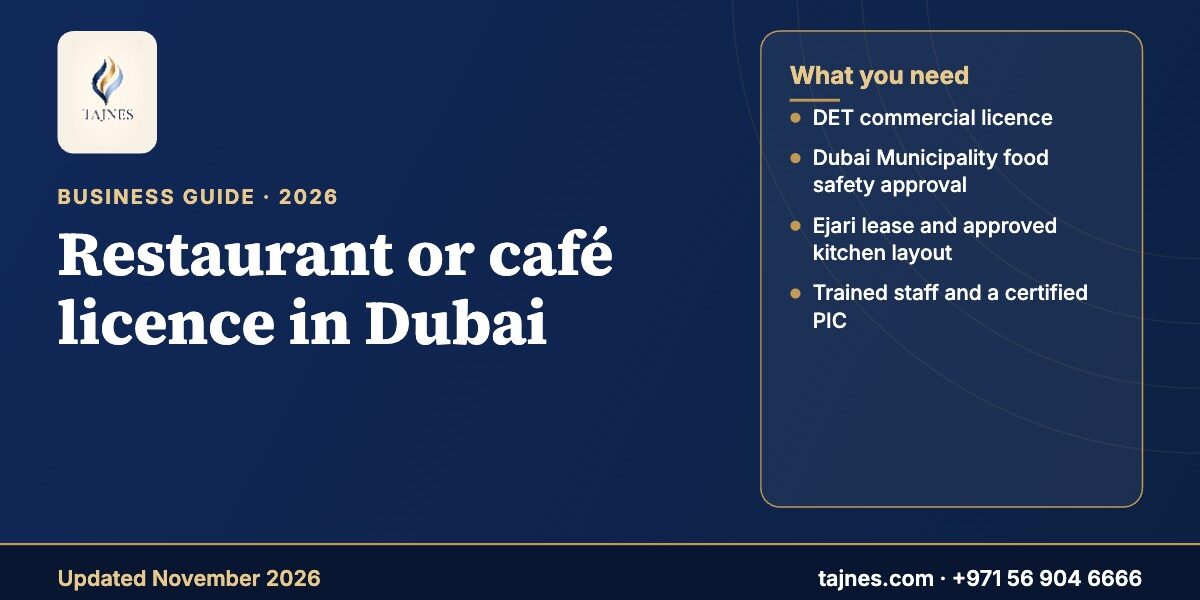
To open a café in Dubai or start a cafeteria business, first pick the right Dubai Municipality activity: a coffee shop needs at least 150 sq ft of food area and a cafeteria at least 200 sq ft. To open a restaurant or café in Dubai, you need a commercial trade licence from the Department of Economy and Tourism (DET) for a food activity such as “Restaurant”, “Cafeteria” or “Coffee Shop”, plus Dubai Municipality food safety approval for your premises. Food outlets cannot use the instant licence: you need a suitable leased space registered in Ejari, approved kitchen layout and fit-out, Civil Defence approval where it applies, and trained staff with a certified Person in Charge before you open. Costs depend mostly on the premises and fit-out, not on the licence itself.
Key facts
- Licence: DET commercial licence on the Dubai mainland, applied for through Invest in Dubai.
- Minimum kitchen size (Dubai Municipality): restaurant 300 sq ft, cafeteria 200 sq ft (250 sq ft with shawarma), coffee shop 150 sq ft.
- Approvals: Dubai Municipality Food Safety Department, plus building, planning, drainage and Civil Defence approvals when applicable.
- People: every food handler needs basic food safety training before working; every outlet needs a certified Person in Charge (PIC) on each shift.
- New in 2026: Dubai Law No. 2 of 2026 on Public Safety (in force 1 June 2026) covers restaurants and cafés as public places.
Which licence and activity do you need?
Pick the activity that matches your concept, because Dubai Municipality sets a minimum kitchen area for each. In its published activity requirements, “Restaurant” (5610001) needs a kitchen of at least 300 sq ft, “Cafeteria” (5610003) at least 200 sq ft (250 sq ft if you serve shawarma), and “Coffee Shop” (5630001) at least 150 sq ft; the area may need to be larger depending on what you cook. None of these activities can be issued as an instant licence, because each needs Food Safety Department approval. Read how to choose business activities before you book the trade name.
Most foreign owners open a mainland LLC so they can own 100% and limit personal liability: compare sole establishment vs LLC in Dubai.
How to get a restaurant licence in Dubai: 7 steps
- Concept and activity: choose restaurant, cafeteria or coffee shop and check the kitchen size you need.
- Trade name and initial approval: reserve the name and get initial approval from DET on Invest in Dubai (see trade name in Dubai).
- Premises: lease a unit suitable for food (ventilation, drainage, gas or electric cooking) and register the lease in Ejari; Dubai Land Department fees are AED 177.75 on the Dubai REST app (see Ejari and office requirements).
- Layout and fit-out approvals: submit the kitchen layout for Dubai Municipality food safety review and get the fit-out permits for the works, plus Civil Defence approval where it applies. Do not start building before the layout is approved.
- Licence: DET issues the commercial licence once the required approvals are in place.
- Pre-opening: register on Dubai Municipality’s FoodWatch platform, pass the inspection, and train your team.
- Extras: shopfront sign permit, outdoor seating, delivery-app listings, VAT registration when you pass AED 375,000 of taxable sales.
Staff: food safety training and the Person in Charge
Under Dubai Municipality’s training rules (guideline DM-FSD-GU64), every food handler must complete basic food safety training before working in food areas, with a refresher every 3 years. Restaurants need a Person in Charge trained to the advanced level on every shift in the kitchen, and cafeterias and cafés one per shift in the kitchen; the PIC certificate is valid for 5 years. Training and PIC records are managed on FoodWatch. Staff also need residence visas and the health screening; see UAE residence visa through your company.
Signs, outdoor seating and public safety
- Shopfront sign: DET issues trade-name sign permits. The sign shows one trade name, horizontal and static, with Arabic above English, and nothing above the ground floor (Dubai Media Office, May 2026).
- Outdoor seating: Dubai Municipality publishes an outdoor seating area guideline; seating on a terrace or pavement needs approval, often with the mall or landlord.
- Public safety: Law No. 2 of 2026 requires the owner of a public place to appoint an accredited public safety supervisor and keep a risk assessment and emergency plan. Existing outlets have a transition period of 2 years.
What does it cost?
DET charges licence fees by activity, and Dubai Municipality and Civil Defence charge for their own services; no single official “restaurant licence price” is published. In practice the largest costs are rent, fit-out, kitchen equipment and staff. As a reference, Dubai Municipality’s 2020 schedule listed AED 200 for a food kiosk and AED 160 for a food truck approval; check current fees before you budget. Use our cost calculator for the licence and visa part, and we give you an open-book quote with every government fee shown.
How to open a café or cafeteria in Dubai: coffee shop vs cafeteria, shisha and opening hours
Dubai Municipality (DM) sets the activity and the minimum food preparation area. Its food establishment requirements list “Coffee Shop” (activity 5630001: hot and cold drinks and fresh juice, with ready-to-eat snacks, sweets and ice cream on display) at a minimum of 150 sq ft, “Cafeteria” (5610003: snacks, sandwiches, drinks and juice) at 200 sq ft, or 250 sq ft with shawarma, and “Restaurant” at 300 sq ft of kitchen. DM may ask for more space depending on your equipment, storage and volume. Neither a coffee shop nor a cafeteria can use the instant licence.
- Choose the activity and check it on Invest in Dubai, then reserve the trade name (published DET fee AED 620; see our trade name guide).
- Lease a unit that suits food use (mall units also need the landlord’s fit-out approval) and register the lease in Ejari.
- Submit the layout for DM assessment on Foodwatch, then apply for the DM food permit. DM’s Unified Permit System, shown at Gulfood 2025, cut the service time for food permits by about 75%.
- Get Civil Defence and building approvals where the unit needs them, finish the fit-out and pass the DM inspection.
- Train your staff and appoint a certified Person in Charge for every shift, then open and report through Foodwatch.
Opening hours: the DET FAQ says coffee shops may open until 2 am, and restaurants and cafeterias can get a permit to open until 3 am if they are on a main road and not in a residential area.
Shisha: serving shisha needs a separate DM Health and Safety permit for a designated smoking area. DM’s technical guideline (version 6, August 2026) asks for an approved layout showing the smoking area, the non-smoking area and the shisha preparation room, at least 7.5 m from main building entrances, no one under 18 (with a sign at the entrance), self-closing doors between indoor areas, and tobacco service from 10 am to midnight unless a permit allows longer. Tobacco may not be sold or displayed within 150 m of a school or kindergarten entrance or 100 m of a place of worship.
DET does not publish one fixed price for a cafeteria or coffee shop licence; the total depends on the activity, the rent, approvals and the fit-out. Use our cost calculator for the licence side and add the fit-out and equipment separately.
Frequently asked questions
How much does a cafeteria licence cost in Dubai?
There is no single official price. Your budget includes the DET licence fees for the activity, the trade name (AED 620), Ejari registration (AED 177.75 online), DM layout assessment and permits, any Civil Defence approval, staff training and the fit-out, which is often the largest cost. Ask for a written quote that lists each government fee separately, or use our cost calculator.
Can I open a café in Dubai with a free zone licence?
Only inside that free zone’s area and with its F&B rules. To serve the public on the Dubai mainland (streets, malls, residential areas), you need a DET licence for the premises.
Can I sell food from home in Dubai?
Not without a licence. Dubai Municipality says home food sales need a DET licence first, followed by its inspection. The Intelaq home licence, which allows some food preparation activities, is for UAE and GCC nationals.
How long does it take to open a restaurant in Dubai?
The licence itself is quick once approvals are in, but layout approval, fit-out and inspection usually take several weeks to a few months, depending on the unit and the works.
Does a restaurant need a Person in Charge?
Yes. Every food establishment in Dubai needs a certified PIC, and restaurants need one on every shift in the kitchen.
Planning a restaurant or café? Book a free consultation, estimate your licence and visas with the cost calculator, or see all our company setup services. Call or WhatsApp +971 56 904 6666.
New guides: food truck, kiosk and home kitchen licences in Dubai and Civil Defence approval in Dubai.
General information, updated November 2026, based on Dubai Municipality food safety requirements and guidelines, Dubai Law No. 2 of 2026 on Public Safety (Dubai Legislation Portal), Dubai Media Office, Dubai Land Department and Invest in Dubai. Rules and fees change; confirm with each authority before you sign a lease or start works. Not legal advice. Alcohol licensing is not covered.