A general trading licence in Dubai lets one company import, export, store and sell a wide range of unrelated products under a single licence, instead of being limited to one product group. You can get it on the mainland from the Department of Economy and Tourism (DET) or from a free zone such as JAFZA, DMCC or DAFZ, and the fee is usually higher than for a standard trading licence. Below we explain what it covers, what it costs according to official fee schedules, which goods need extra approvals and how to apply.
Key facts
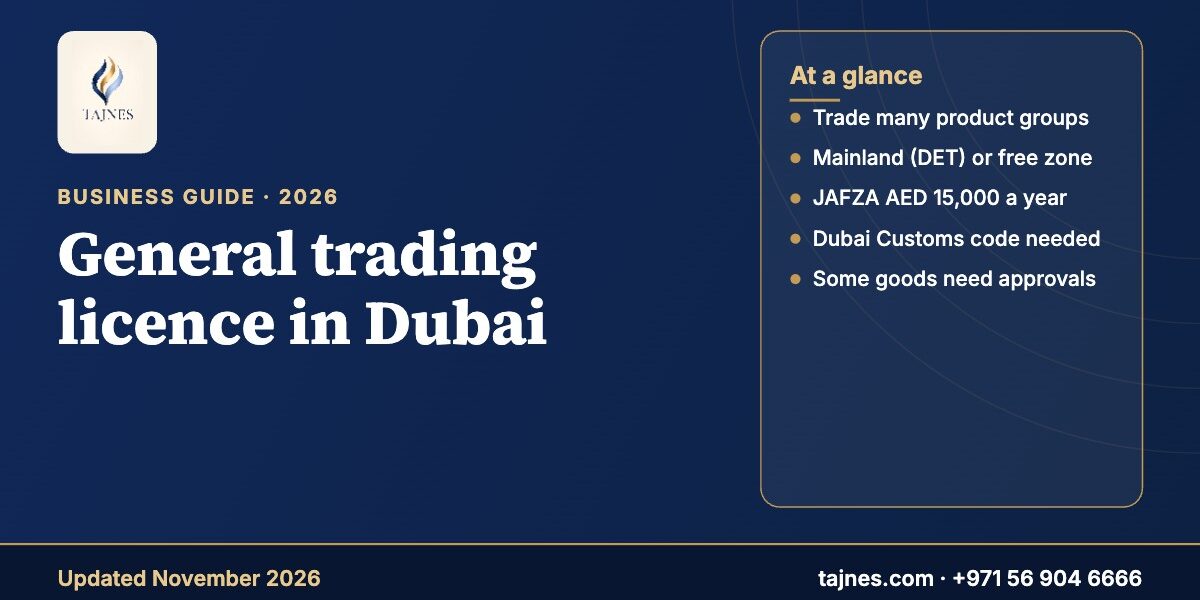
- What it is: a trading licence that covers activities from several product groups. JAFZA, for example, treats a licence with activities from more than two groups as a general trading licence.
- Where: Dubai mainland (DET, on Invest in Dubai) or a free zone (JAFZA, DMCC, DAFZ and others).
- Published fees (examples): JAFZA general trading AED 15,000 a year; DMCC general trading licence AED 50,265 a year. Fees change, so confirm before you apply.
- Customs: you need a Dubai Customs client code to import or export (published fee AED 100 + AED 20).
- Duty: most goods pay 5% customs duty on the CIF value; UAE tariffs range from 0% to 5%.
- Tax: VAT registration is mandatory above AED 375,000 of taxable supplies; corporate tax is 0% up to AED 375,000 of taxable income and 9% above.
General trading licence vs standard trading licence
A standard trading licence covers related activities in one product group, for example electronics or textiles. A general trading licence lets you trade across many groups, which suits companies that source different products for different clients, re-export to other markets or are not yet sure which products will sell best. JAFZA’s licence guide describes three trading levels: one group, two groups, and “general trading” from three groups upwards. A trading licence is also what you need to hold inventory; it does not allow manufacturing, which needs an industrial licence.
Mainland or free zone?
Mainland (DET): you can sell directly anywhere in the UAE, bid for local contracts and open shops or showrooms. Most activities allow 100% foreign ownership, except strategic sectors; check your chosen activities on Invest in Dubai. You need a physical address with an Ejari-registered lease, and DET-licensed businesses must also join Dubai Chambers (micro and small enterprises are exempt under Law No. 1 of 2022). Dubai’s 2011 fee resolution set a separate general trading fee (AED 15,000 to issue, AED 3,000 to renew) on top of the base licence fee; check today’s figure in DET’s fee calculator.
Free zone: 100% ownership, a warehouse or office inside the zone, and easy re-export. Published examples: JAFZA charges AED 15,000 a year for general trading (AED 5,000 for one group, AED 8,500 for two); DMCC lists AED 50,265 a year for its general trading licence and AED 215 to obtain a Dubai Customs code; DAFZ’s general trading licence covers import, export, re-export, storage and distribution of any non-hazardous, legal goods. Selling into the mainland from a free zone usually goes through a local distributor or a mainland permit; see our guide to the dual licence in Dubai. For a wider comparison, read mainland vs free zone.
Goods that need extra approvals
A general trading licence does not cover everything. Dubai Customs releases restricted goods only with the approval of the competent authority, for example:
- food and cosmetics: Dubai Municipality;
- medicines and medical devices: Ministry of Health and Prevention;
- live animals, plants, fertilisers and pesticides: Ministry of Climate Change and Environment;
- radio and transmitter equipment: the telecoms regulator;
- new tyres and e-cigarettes: the standards authority;
- publications: the media regulator.
Some goods are banned outright, such as used or retreaded tyres and gambling devices. Check each product line before you sign supplier contracts.
How to get a general trading licence, step by step
- List your products and match them to licence activities and groups.
- Choose mainland or free zone and the legal form (for example an LLC or a free zone company). Our guide on choosing business activities helps here.
- Reserve the trade name and get initial approval. See trade name rules in Dubai.
- Sign the lease for an office or warehouse (Ejari on the mainland).
- Get any external approvals for regulated goods.
- Pay the fees and collect the licence, then register with Dubai Customs (trade licence, passport and Emirates ID of the authorised person; about one working day).
- Open a corporate bank account and apply for visas.
Tax for trading companies
Register for VAT once taxable supplies and imports pass AED 375,000 in 12 months (voluntary from AED 187,500). Every company registers for corporate tax: 0% up to AED 375,000 of taxable income and 9% above. Free zone incentives apply only to businesses that meet the qualifying rules. See our guides to VAT registration and corporate tax for small businesses.
Frequently asked questions
How much does a general trading licence cost in Dubai?
It depends on the authority. Published examples include AED 15,000 a year at JAFZA and AED 50,265 a year for a DMCC general trading licence, plus office or warehouse rent, visas and other fees. Use our cost calculator for an estimate.
Can a foreigner own 100% of a general trading company?
In free zones, yes. On the mainland, most activities are open to 100% foreign ownership, but check your exact activities on Invest in Dubai before you apply.
Can I trade medicines or food with a general trading licence?
Only with the extra approval of the relevant authority, such as the Ministry of Health and Prevention or Dubai Municipality.
Do I need a warehouse?
Not always. You need a registered office or premises; a warehouse depends on your goods and on the free zone’s rules.
Next steps
Tajnes can map your products to the right activities, compare mainland and free zone options and handle the licence, customs code, visas and bank account, with open-book pricing. Book a free consultation, try the cost calculator or see our services.
Related guide: selling services instead of goods? Read our guide to the professional licence in Dubai.
Related guide: trading from Sharjah instead? See Sharjah trade licence renewal and cost, including how general trading licences work with SEDD.
Related guide: e-commerce licence in Dubai and the e-Trader licence for expats.
New guide: Dubai Customs code: import/export registration, duty and steps.
Related guide: need to add an activity, a partner or a new address? See how to change a company licence in Dubai and the UAE.
New guide: fitting out premises or storing goods? See our guide to Civil Defence approval in Dubai.
Related guide: how to open a branch office in Dubai – fees, documents and timeline.
General information, updated November 2026, based on JAFZA, DMCC, DAFZ, Dubai Customs, u.ae, MoET and the Dubai Legislation Portal. Fees and rules change; confirm with the authority before you apply. Not legal or tax advice.