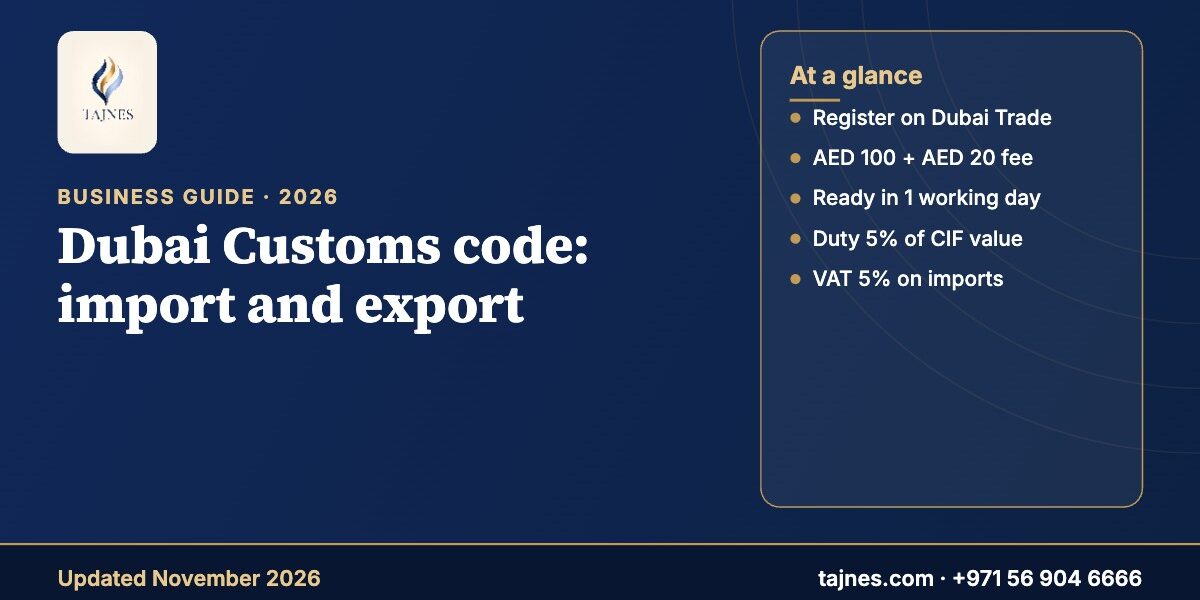
To import or export goods through Dubai, your company needs a Dubai Customs code (business registration). You apply online through Dubai Trade with your trade licence and the passport and Emirates ID of the authorised person; Dubai Customs lists a fee of AED 100 plus AED 20 and a processing time of one working day. Duty is generally 5% of the CIF value, and VAT of 5% also applies on imports.
Key facts
- Service name: “Request Business Registration” with Dubai Customs, through the Dubai Trade portal (Mirsal 2).
- Fee: AED 100 plus a AED 20 Knowledge and Innovation fee; renewal AED 25 (Dubai Customs Services Guide).
- Time: 1 working day; the code is sent by email.
- Validity: linked to your trade licence; renew the licence first, then the code.
- Customs duty: 5% of CIF value for most goods; 50% on alcohol and 100% on tobacco (u.ae, October 2026).
- VAT on imports: 5%; VAT-registered importers can account for it in their VAT return.
What is a Dubai Customs code and who needs one?
The customs code, often called an importer/exporter code or client code, lets a business deal with Dubai Customs officially: file declarations, pay duty, post deposits and clear shipments. Any business licensed in the UAE or the GCC can apply. The activities on your licence must match the business type you register, so a general trading licence or a trading activity that covers your goods comes first. If you are still choosing, see how to choose business activities.
Mainland and free zone companies
Mainland companies register with their DET licence. Free zone companies register as a “Free Zone Company” type, at the same AED 100 registration fee, and staff who deal with customs for a free zone company need a no-objection letter from the free zone authority for their representative card. Some free zones also charge their own fee: DMCC, for example, lists a customs code fee of AED 215 in its schedule of charges. Goods can move into a free zone without duty, but duty is due when they enter the local UAE market. If goods leave a free zone without proof of export, Dubai Customs can charge 10% of the CIF value. Not sure which base suits you? Compare mainland and free zone.
How to get a Dubai Customs code: step by step
- Check your licence activities match the goods you will import or export.
- Create a Dubai Trade account and open the Mirsal 2 business registration service.
- Upload the documents: trade licence, and passport and Emirates ID copies of the authorised person.
- Pay the fee (AED 100 + AED 20) and wait about one working day for the code by email.
- Get representative cards for staff who will deal with customs (AED 150 each, per the Dubai Customs Services Guide), or authorise a licensed customs broker on Dubai Trade.
- Link your customs code to your VAT number (TRN) with the FTA if you are VAT-registered, so import VAT can be reported in your return. See our guide to VAT registration in the UAE.
Customs declarations, brokers and duty
Dubai Customs works with five customs regimes (import, export, transit, transfer and temporary admission) and about 40 declaration types, such as import to the local market or import for re-export. Each declaration has its own fee; for example, an export declaration is AED 100 in the Dubai Customs fee schedule. Most companies use a licensed customs broker. You authorise the broker electronically on Dubai Trade and can limit which declarations it may file and for how long; the broker is responsible for the accuracy of what it declares.
- Import for the local market: duty of 5% of CIF (cost, insurance and freight), unless an exemption applies.
- Import for re-export: a deposit or guarantee equal to the duty, refunded when the goods leave within the allowed period (six months in the Dubai Customs customer guide).
- Temporary admission: a deposit equal to the duty, refunded on re-export; ATA carnet goods need no deposit.
- Exemptions include some industrial inputs (with Ministry approval), returned goods and personal effects; check before you ship.
Not sure of your HS code? Dubai Customs launched the “Al Munasiq” smart app in February 2025: it classifies goods from text, voice or a photo and shows the duty rate and restrictions.
Restricted goods and penalties
Restricted goods need a permit from the controlling authority when you declare them: for example medicines and medical devices (Ministry of Health and Prevention), live animals (Ministry of Climate Change and Environment), telecom equipment (TDRA) and printed media. Prohibited goods cannot be imported at all. Dubai Customs lists fines such as AED 500 for an incorrect declaration and a daily fee for documents submitted late, so check paperwork before each shipment.
Frequently asked questions
How much does a Dubai Customs code cost?
Dubai Customs lists AED 100 for a new business registration plus a AED 20 Knowledge and Innovation fee, and AED 25 to renew it. Free zones may add their own fee, and brokers charge for their services.
Do I need a customs code for e-commerce?
If your company imports stock in its own name, yes. If a marketplace or logistics provider imports on your behalf, ask who is the importer of record. Our e-commerce licence guide covers the licence side.
Can a free zone company sell imported goods in Dubai?
Goods leaving a free zone for the local market pay customs duty, and selling on the mainland needs the right permit or a mainland licence. See our guide to the dual licence in Dubai.
Can Tajnes register my customs code?
Yes. We prepare the licence activities and documents, open the Dubai Trade registration and coordinate with your broker. Our services are open-book: official fees are shown at cost.
Planning to import or export? Book a free consultation or estimate your setup with our cost calculator.
Related guide: How to close a company in Dubai: liquidation, licence cancellation and tax.
Related guide: setting up in the UAE as an existing foreign company? See branch setup in Dubai and the UAE: MoET steps, fees and documents.
Related guide: how to open a café, cafeteria or restaurant in Dubai: DM minimum areas, approvals, shisha permit and costs.
General information, updated November 2026, based on Dubai Customs (Customs Services Guide and service pages), u.ae and FTA sources. Fees and rules change; confirm with Dubai Customs, your free zone and the FTA before you act. Not legal or tax advice.